Thursday, November 8, 2012
My Favorite Philosopher

Thursday, November 1, 2012
Prioner's Dilemma
Hey Y'all!
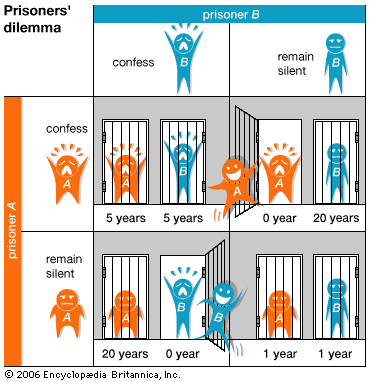
Hope you head a great Halloween! Too bad it was on a wednesday as that falls right during the time of midterms; in that case I wish you the best of luck! Today I'm going to talk a bit about the Prisoners Dilemma, an economic game I find particularly interesting because the conflict it presents always brings out my indecisive side.
Prisoners Dilemma really gets at the crux of game theory and what I find truly intriguing about it is how human beings will be hesitant to cooperate with each other due to self interest and a lack of trust in the other person, regardless of how the cooperation may benefit them. Inherent in the design is the fact that betrayal of the other "prisoner" yields a better reward (in this case a lesser sentence) than cooperation does, however contrary to what one would think, people tend to show a bias towards cooperation.
If you want some information as to how this is set up just click on this link!
http://en.wikipedia.org/wiki/Prisoner's_dilemma
Thanks and Best of Luck!
 Chris
Chris
Hope you head a great Halloween! Too bad it was on a wednesday as that falls right during the time of midterms; in that case I wish you the best of luck! Today I'm going to talk a bit about the Prisoners Dilemma, an economic game I find particularly interesting because the conflict it presents always brings out my indecisive side.
Prisoners Dilemma really gets at the crux of game theory and what I find truly intriguing about it is how human beings will be hesitant to cooperate with each other due to self interest and a lack of trust in the other person, regardless of how the cooperation may benefit them. Inherent in the design is the fact that betrayal of the other "prisoner" yields a better reward (in this case a lesser sentence) than cooperation does, however contrary to what one would think, people tend to show a bias towards cooperation.
If you want some information as to how this is set up just click on this link!
http://en.wikipedia.org/wiki/Prisoner's_dilemma
Thanks and Best of Luck!
Thursday, October 25, 2012
Violating the Norms
Hi y'all!
It's been a while, hope everyone enjoyed their fall breaks! I've been good, just chugging on through classes and the usual routine, but I took some time this week to break from that routine, and I went boldly where most men usually don't go...not actually, but I did violate a social norm! So after studying the still face paradigm and how it affects babies, I thought, "hey, why not give this a try on people my own age!" Humans rely on social cues to adapt to various situations, and so i was curious to see what would happen when you take those social cues away.
In order to do this, I kept a straight face for as long as possible during my interactions with friends. This included:
 Chris :)
It's been a while, hope everyone enjoyed their fall breaks! I've been good, just chugging on through classes and the usual routine, but I took some time this week to break from that routine, and I went boldly where most men usually don't go...not actually, but I did violate a social norm! So after studying the still face paradigm and how it affects babies, I thought, "hey, why not give this a try on people my own age!" Humans rely on social cues to adapt to various situations, and so i was curious to see what would happen when you take those social cues away.
In order to do this, I kept a straight face for as long as possible during my interactions with friends. This included:
- no smiling
- no nodding
- blank stares
- subtle hints of apathy with body language
and what I found out went a little something like this...I would first engage the person normally, so as to get a conversation going, then, as soon as they started explaining something to me or telling me a story I became stonewall Jackson, not a single emotion showed on my face, no response was given. Before the switch to still-face, the other person was speaking normally, but then all of a sudden, realized that I was not giving any reaction to the, "cool," things they had to say. This manifested itself in the following ways:
- slowed speech
- lowering of eyebrows
- looks of confusion
- jittery movements
- loss of eye contact
- early termination of interaction
This was pretty constant across everyone I did this too. When we stop reacting to people, and they lose those social cues, people tend to be at a loss. The cool thing is though, after going still face, once I reverted back to normal, the conversation was able to continue as it normally had before the switch. I did get cursed at by some of my closer friends, but that is the cost of science!
Anyway, hope all of you are well and have a great week!
Best,

Thursday, October 4, 2012
What's Up With These Emotions?
Fellow Neuro Peeps,
Hope everyone is hanging in there! Midterm week is insane, I AM REALLY ANGRY! lol jk not really, just frustrated, but the reason I used anger is because I will be talking about emotion today! So what really is emotion? My answer is, who knows! When I was younger I believed that emotions came from the heart where thinking and logic came from the brain, hence the sayings, " I LOVE YOU WITH ALL MY HEART!" or ," IF I THINK ANY HARDER MY BRAIN WILL EXPLODE!". Well, I now know that emotions don't come from the heart, but I also believe emotion isn't tied to the neocortex or higher level processing. It's hard to find a satisfactory definition of emotion, part of me wants to say that emotions are pure, raw feelings that come from within (but that sort of sounds like something our favorite purple dinosaur would say). Ancient Greece would argue that emotions are the result of some foolish woman by the name of Pandora who opened a nice big box of emotion...thanks Pandora! But all jokes aside, emotions are something that have been around as long as humans have. To me, emotions are impulses that are second nature to humans, hardwired into the lower cortical regions of our brain, leading us to make snap second decisions and judgements before trying to think things through. Emotions are like the reflexes of the brain! Emotions are like m&m's, there are many different varities and colors within that variety, representative of different degrees of each different emotion. I love m&m's and I love Emotions! i'm just that kind of guy!
Tell me what ya think, leave a tone!

Hope everyone is hanging in there! Midterm week is insane, I AM REALLY ANGRY! lol jk not really, just frustrated, but the reason I used anger is because I will be talking about emotion today! So what really is emotion? My answer is, who knows! When I was younger I believed that emotions came from the heart where thinking and logic came from the brain, hence the sayings, " I LOVE YOU WITH ALL MY HEART!" or ," IF I THINK ANY HARDER MY BRAIN WILL EXPLODE!". Well, I now know that emotions don't come from the heart, but I also believe emotion isn't tied to the neocortex or higher level processing. It's hard to find a satisfactory definition of emotion, part of me wants to say that emotions are pure, raw feelings that come from within (but that sort of sounds like something our favorite purple dinosaur would say). Ancient Greece would argue that emotions are the result of some foolish woman by the name of Pandora who opened a nice big box of emotion...thanks Pandora! But all jokes aside, emotions are something that have been around as long as humans have. To me, emotions are impulses that are second nature to humans, hardwired into the lower cortical regions of our brain, leading us to make snap second decisions and judgements before trying to think things through. Emotions are like the reflexes of the brain! Emotions are like m&m's, there are many different varities and colors within that variety, representative of different degrees of each different emotion. I love m&m's and I love Emotions! i'm just that kind of guy!
Tell me what ya think, leave a tone!
Thursday, September 27, 2012
This Is Your Brain on Jazz
I love jazz music. It's one of the most soothing, emotionally driven genres of music out there. I go to see the Duke Jazz ensemble all the time and whenever I have some spare time, I check out the Mary Lou. For me, the best music to study to is jazz, where a sexy saxophone compliments the cool vibes of the xylophone, always freeing me from the grasp of writers block. Hot Damn!! can those jazz musicians free style! The reason I bring this up is because one of the most fascinating fMRI studies I've ever hear about studied jazz improvisation. This study was performed at Johns Hopkins using jazz pianists from their Peabody Institute. The study was divided into four exercises.
"Each musician first took part in four different exercises designed to separate out the brain activity involved in playing simple memorized piano pieces and activity while improvising their music. While lying in the fMRI machine with the special keyboard propped on their laps, the pianists all began by playing the C-major scale, a well-memorized order of notes that every beginner learns. With the sound of a metronome playing over the headphones, the musicians were instructed to play the scale, making sure that each volunteer played the same notes with the same timing.
The key finding of this study was that during times of improvisation, the dorsolateral prefrontal cortex, linked to planning and self-censoring, exhibited a significant decrease in activation hinting at the idea that less activation means less inhibitions. There was also increased activation of the prefrontal cortex, linked to self-expression and individuality.
How cool is that! The brain shuts off inhibition and increases self-expression when being creative, it frees itself from censorship and lets you take total control. I think this is awesome!
 What do you guys think?
"Each musician first took part in four different exercises designed to separate out the brain activity involved in playing simple memorized piano pieces and activity while improvising their music. While lying in the fMRI machine with the special keyboard propped on their laps, the pianists all began by playing the C-major scale, a well-memorized order of notes that every beginner learns. With the sound of a metronome playing over the headphones, the musicians were instructed to play the scale, making sure that each volunteer played the same notes with the same timing.
In the second exercise, the pianists were asked to improvise in time with the metronome. They were asked to use quarter notes on the C-major scale, but could play any of these notes that they wanted. Next, the musicians were asked to play an original blues melody that they all memorized in advance, while a recorded jazz quartet that complemented the tune played in the background. In the last exercise, the musicians were told to improvise their own tunes with the same recorded jazz quartet.."
The key finding of this study was that during times of improvisation, the dorsolateral prefrontal cortex, linked to planning and self-censoring, exhibited a significant decrease in activation hinting at the idea that less activation means less inhibitions. There was also increased activation of the prefrontal cortex, linked to self-expression and individuality.
How cool is that! The brain shuts off inhibition and increases self-expression when being creative, it frees itself from censorship and lets you take total control. I think this is awesome!

Thursday, September 20, 2012
Brains, Minds, and Ethics
Fellow Amigos,
 How's everything?! I didn't mention this to anyone but my blog was flagged for spam last week...finally got that taken care of and i'm back with a vengeance... Anyway, today I want to comment on how much technology has advanced and where it could possibly advance to in the future. I'm sure i'm not alone when I say I went through a superpower phase wanting to fly, have telekinesis, telepathy, and the ability to read minds. Most people site these powers a their top favorites, yet as we get older, we sort of veer away from wanting the ability to read minds, mainly because some things are better left unsaid. That it mind, its highly feasible that mind reading can become a reality in the near future...but is that something we really want? If I was given a genius brain that was predestined to invent innovative and exciting technology (as opposed to struggling to understand a science article) I think 99.9 times out of a hundred, I would opt out of inventing a mind reading machine and instead create the perfect brain reading machine. Why? The short answer is because completely understanding the biology and functionality of the brain will open up al sorts of doors to new medications and procedures to improve the fight against brain diseases and disorders. The other answer...well, how can we morally justify a ind reading device? In this day in age, our thoughts are really the only privacy we have. Though reading minds can grant psychologists more insight to the way people think and behave, or maybe even a better understanding of the disordered schizophrenic brain, there are strong ethic violations that seem evident. This machine can easily become a tool of the military when holding POW's, and just invades something that is sacred to every individual. For these reasons I say, give us the brain machine!
 How's everything?! I didn't mention this to anyone but my blog was flagged for spam last week...finally got that taken care of and i'm back with a vengeance... Anyway, today I want to comment on how much technology has advanced and where it could possibly advance to in the future. I'm sure i'm not alone when I say I went through a superpower phase wanting to fly, have telekinesis, telepathy, and the ability to read minds. Most people site these powers a their top favorites, yet as we get older, we sort of veer away from wanting the ability to read minds, mainly because some things are better left unsaid. That it mind, its highly feasible that mind reading can become a reality in the near future...but is that something we really want? If I was given a genius brain that was predestined to invent innovative and exciting technology (as opposed to struggling to understand a science article) I think 99.9 times out of a hundred, I would opt out of inventing a mind reading machine and instead create the perfect brain reading machine. Why? The short answer is because completely understanding the biology and functionality of the brain will open up al sorts of doors to new medications and procedures to improve the fight against brain diseases and disorders. The other answer...well, how can we morally justify a ind reading device? In this day in age, our thoughts are really the only privacy we have. Though reading minds can grant psychologists more insight to the way people think and behave, or maybe even a better understanding of the disordered schizophrenic brain, there are strong ethic violations that seem evident. This machine can easily become a tool of the military when holding POW's, and just invades something that is sacred to every individual. For these reasons I say, give us the brain machine!
Wednesday, September 12, 2012
My First Encounter
Hey Guys,
Hope everyone is having a great week! Also stay healthy! I have unfortunately been chilling with sickness for the past few days but hopefully it goes away soon! College dorms are something else aren't they? Anyway, today I'd like to talk about my first encounter with a brain disorder, one that claimed the life of someone dear to me. Before the diagnosis, I had no idea what Neuroscience was or what type of brain diseases existed but it is ultimately what sparked my interest in the field.
Coming from an Italian-Greek household, family is something that is cherished deeply and i've aways had extended family over growing up for as long as I can remember. My grandmother lived with me my whole life and was, as a result, a second mother to me. When I was going into my first year of High School, one of her doctors noticed something off about the way she walked and sent her to a Neurologist to get looked at. It was then that we learned she had Parkinson's Disease, a brain disorder that results from a dopamine neuron death in the substantia nigra.
My Grandmother had always been a strong woman, taking care of my mom and two uncles on her own after my Grandfather died due to heart failure. When I was younger she would take me to work with her and we would go play in the park afterwards. She was very active, always refusing to sit down, always trying to clean every last square inch of the house, and always dancing to some Sinatra. I looked up to her, and when I found out she had Parkinson's I took a special interest in neuroscience. She used to tell me about her doctor visits and would have me look up symptoms and causes for the disease. I found it all fascinating but I hated the disease so much. I looked up videos of Michael J. Fox after he had parkinson's and was scared for what it would do to my Grandma. The years following were miserable for me. I slowly watched as the disease ate away at her strength. She would shake constantly and drag her feet while she walked. She didn't have the strength to do all the trivial household things she used to do and she would fight her fatigue to do it anyway. I picked up her medicine whenever she needed refills, i'll never forget the name "Carbidopa-Levodopa". The disease claimed her life early second semester of my Freshman Year and I swore to accomplish what i promised my Grandma, to become a doctor that specialized in neuroscience and treat my patients better than her doctors had treated her.
This was my first encounter, and this is my motivation.
Hope everyone is having a great week! Also stay healthy! I have unfortunately been chilling with sickness for the past few days but hopefully it goes away soon! College dorms are something else aren't they? Anyway, today I'd like to talk about my first encounter with a brain disorder, one that claimed the life of someone dear to me. Before the diagnosis, I had no idea what Neuroscience was or what type of brain diseases existed but it is ultimately what sparked my interest in the field.
Coming from an Italian-Greek household, family is something that is cherished deeply and i've aways had extended family over growing up for as long as I can remember. My grandmother lived with me my whole life and was, as a result, a second mother to me. When I was going into my first year of High School, one of her doctors noticed something off about the way she walked and sent her to a Neurologist to get looked at. It was then that we learned she had Parkinson's Disease, a brain disorder that results from a dopamine neuron death in the substantia nigra.
My Grandmother had always been a strong woman, taking care of my mom and two uncles on her own after my Grandfather died due to heart failure. When I was younger she would take me to work with her and we would go play in the park afterwards. She was very active, always refusing to sit down, always trying to clean every last square inch of the house, and always dancing to some Sinatra. I looked up to her, and when I found out she had Parkinson's I took a special interest in neuroscience. She used to tell me about her doctor visits and would have me look up symptoms and causes for the disease. I found it all fascinating but I hated the disease so much. I looked up videos of Michael J. Fox after he had parkinson's and was scared for what it would do to my Grandma. The years following were miserable for me. I slowly watched as the disease ate away at her strength. She would shake constantly and drag her feet while she walked. She didn't have the strength to do all the trivial household things she used to do and she would fight her fatigue to do it anyway. I picked up her medicine whenever she needed refills, i'll never forget the name "Carbidopa-Levodopa". The disease claimed her life early second semester of my Freshman Year and I swore to accomplish what i promised my Grandma, to become a doctor that specialized in neuroscience and treat my patients better than her doctors had treated her.
This was my first encounter, and this is my motivation.
Subscribe to:
Posts (Atom)